
PUBLIC INTEREST CRITERION (PIC) 4020- Bogus document or false or misleading information.

PIC 4020 is an integrity measure which is designed to prevent fraud within the visa migration programme. Public interest criteria 4020 allows the minister to refuse a visa if the applicant provides bogus documents or information that is false or misleading in relation to a visa application or visa held. 

What is Bogus Document?

Some examples of bogus document are as follows:

  1. A document belonging to another person that is presented to the department by the visa applicant as their own.
  2. A document that has been altered by a person who does not have the authority such as digital altered photos to support claims of relationship.
  3. A document obtained by false or misleading statement such as English language test that was achieved by an imposter.

What is false or misleading information?

Examples or false or misleading information are as follows:  

  1. False or inaccurate statements or information in a document, application, or declaration.
  2. A false or misleading employment reference in support of an applicant’s work experience claims.
  3. False or misleading information about a secondary and or non-migrating dependant’s relationship to the primary applicant.
  4. A mistake made by others is not a defence for defeating PIC 4020, even if the mistakes are made by a Migration Agent.

It is important to note that a typographical error where an incorrect street address or birth date for a child is included in an application would likely not be false or misleading in a material particular under PIC 4020 (as noted in policy but be aware that this is not binding on the Department).

What happens if the Department suspects that PIC 4020 has not be satisfied? 

The Department of Home Affairs will conduct further investigations to establish whether to refuse your visa application due to the inability to meet PIC 4020. As part of this process, you will be notified in writing, and will have the opportunity to comment on this matter (which you must also do in writing). This is called a ‘natural justice’ letter.

What happens if you fail to satisfy PIC 4020 on the basis of a bogus document, or false or misleading information?

If the Department determines that you do not meet PIC 4020 on this basis, it will refuse to grant your visa application. As a result of failing to satisfy PIC 4020, you will also be unable to be granted a further visa for a period of 3 years from the date of refusal.

If you are looking for a professional advice on PIC 4020 and how it applies to your personal situation, book your consultation with us.

Disclaimer

The information in this blog is general. It does not constitute, and should be not relied on as, legal advice. We tries to ensure that the content of this information is accurate, adequate or complete, it does not represent or warrant its accuracy, adequacy or completeness. We are not responsible for any loss suffered as a result of or in relation to the use of this information.

Travel Exemption for International Students and their Dependents

There are hundreds of student stuck overseas waiting for months to return to Australia to resume their studies. However, in order to travel to Australia, an international student require an exemption for travel. The following are few guidelines issued by the Australian Border Force (ABF) commissioner under which an international student may be eligible for travel exemption :

1. People who are enrolled in an Australian education institution as a PhD research student, regardless of the visa type held. Any request from a PhD research student should include evidence of support from a relevant Government agency outlining why the research is considered essential and in Australia’s national interest and how their role is critical to the research.

2. Year 11/12 students (only where a letter of support from their Australian school and the relevant state or territory health authority is provided).

3. a student in your final two years of study of a medical, dental, nursing or allied health profession university degree, where you have evidence of a confirmed placement in an Australian hospital or medical practice which begins within the next two months.

4. Students who are in their final two years of study of a medical, dental, nursing or Allied Health Profession university degree, where they have evidence of a confirmed placement in an Australian hospital or medical practice which commences within the next two months. Allied Health Professions include: Arts therapy, audiology, chiropractic, diagnostic radiographer/medical imaging technologist, dietetics, exercise physiology, genetic counselling, music therapy, occupational therapy, optometry, orthoptics, orthotics/prosthetics, osteopathy, perfusion, physiotherapy, podiatry, psychology, rehabilitation counselling, social work, sonography and speech pathology.

5. travelling for compassionate and compelling reasons.

6. The immediate family member of a non-citizen with critical skills in Australia, where the person in Australia holds a temporary or provisional visa. The impact to Australia should be considered – including if there is a high risk that the person with critical skills will depart Australia if they are unable to reunite with their immediate family member. Objective evidence of the ongoing criticality of the relevant skill from a state or territory government should be given considerable weight.

 7. The partner of a person who is in Australia and in the final trimester of their pregnancy or otherwise due to give birth.

8. Cases demonstrating strong compassionate circumstances that, if not taken into account, would result in serious, ongoing and irreversible harm and continuing hardship to the family unit.

 9. Compassionate circumstances regarding the age and/or health and/or psychological state of the person that, if not taken into account, would result in serious, ongoing and irreversible harm and continuing hardship to the person. 

 10. Strong economic, scientific, cultural or other benefit to Australia would result from the person being permitted to enter Australia. Support from a state, territory or Commonwealth government authority should be given considerable weight.

 11. People with critical skills, including nurses, doctors, medical specialists, engineers, marine pilots and crews. Skills must be critical to Australia’s COVID-19 response or economic recovery. Evidence of current employment in Australia must be provided. Any evidence of support for the applicant from a State, Territory or Commonwealth government authority will be considered favourably. Consideration should include any beneficial economic, health, social or employment outcomes for Australian citizens

In order to receive a successful outcome of your travel exemption application, you must ensure that an evidence based, organised and strong submissions are put forward to satisfy the delegate so that the delegate is able to use their discretion in your favour. We can help you with writing a detailed submission according to your instructions and the evidence provided.

Contact us for a consultation in relation to your Travel Exemption Application. We will assess your circumstances and evidence whether you have a reasonable chance for a successful outcome for your travel exemption application.

200-DAY RULE: “ORDINARILY RESIDENT IN AUSTRALIA”

This article serves as a timely reminder for foreign persons purchasing residential-related property in NSW as Revenue NSW seem to be doing an audit of property transactions for outstanding liabilities for surcharge purchaser duty.

It is important to note that while buying a residential property, there is a distinction between a “permanent resident” and “ordinarily resident”. You will be regarded as a foreign person if you have not lived in Australia for at least 200 days in the 365 days prior to the date of the contract for purchase of the property, even if your visa grants you a permanent resident status.

What is surcharge purchaser duty?

If you acquire an interest in land in NSW, you are usually required to pay an amount of tax on the purchase known as ‘transfer duty’ (formerly known as stamp duty).

If you are considered a ‘foreign person’ for the purposes of the Duties Act 1997 (NSW) (“Duties Act”), you are also required to pay surcharge duty on the dutiable value of the property you are purchasing (known as surcharge purchaser duty). This is in addition to the amount of transfer duty calculated on the acquisition. The rate of duty charged will depend on when the Contract was entered into, but is currently charged at 8%.

Foreign person

You’re generally considered a foreign person, unless:

  • you’re an Australian citizen
  • you’ve lived in Australia for more than 200 days in the 12 months before the purchase date, and you’re:
    • a New Zealand Citizen, who holds a subclass 444 visa or
    • a permanent resident of Australia.

Post-settlement audit by Revenue NSW

At some point in the future, the transaction may be audited by Revenue NSW, who cross-check the information in the Form against various other state and federal government databases. In particular, the information will be checked against the Department of Home Affairs.

If Revenue NSW identify anything that leads them to believe you might be liable for surcharge purchaser duty which has not been paid, they will commence an investigation under Part 9 of the Taxation Administration Act 1996 (NSW). If it is determined that you are liable for surcharge purchaser duty, Revenue NSW may issue a Notice of Assessment for payment of the surcharge duty, plus interest and possible penalty tax. You will be required to pay this extra amount, though Revenue NSW do have discretion to offer payment plans, stop interest accruing or reduce the amount of interest payable if you respond quickly to their notices.

In order to prove that you are ordinarily resident in Australia, you have to provide movement records from the Department of Home Affairs for the 12 month period before the contract date. The movement records can be requested from the Department by submitting a Form 1359. This document, along with your passport, visa grant, and signed and completed Purchaser Declaration Form have to be submitted to Revenue NSW upon its request.

Consequences of Academic Misconduct on International Students and their Visa conditions

In the recent months, we have received a large number of enquires for academic misconduct cases.

This small blog is to help the international students to understand the importance of academic integrity and the legal implications of the academic misconduct. By using this information, the students can avoid inadvertently making mistakes that would land them in an unpleasant situation.

There is no single definition of academic misconduct.

While all forms of academic dishonesty are a serious issue, but the most severe form of misconduct is purchasing of assignments commonly known as contract cheating or impersonation. In simple terms, contract cheating occurs when the student hire someone to complete part or all of your work and then submitting the work as if you had completed it yourself. For instance, having someone to write an essay, report or some other kind of assignment, which is sometimes referred to as ‘ghost-writing’

It is important to note that the term ‘contract cheating’ suggests that some kind of payment is involved, there does not have to be a payment for something to be considered contract cheating.

Impact of Academic Misconduct on International Students

There are certain criteria prescribed by the Department of Home Affairs (DOHA) for the Student Visas. The department has a Genuine Temporary Entrant (GTE) criterion for the Student Subclass 500 visa holders such as maintaining health insurance (8501), work limitation (8104), maximum three months study (8201), must maintain eligibility in the course (8516), but it must be kept in mind that the GTE requirement doesn’t end there.

A student visa holder will be continued to be assessed on if you are a genuine student during the validity of the visa. The student should bear in mind that If you are found to be a non-genuine student, it may lead to the cancellation of your student visa. Your student visa may be cancelled if the student visa holder has arranged another person to attend classes or exams on their behalf or was involved in any form of academic misconduct.

If you are liable for any academic misconduct, the penalties due to disciplinary action may range from academic penalties, restrictions on enrolment, suspension, exclusion or expulsion from an institution and it may imperil a student’s right to stay in Australia, require them to leave the country or lead to their removal from Australia. Such an occurrence may impose considerable costs on a student, effectively mean they are unable to complete their studies, or affect future applications to enter or stay in Australia.

Despite the above, an international student’s right to stay and study in Australia would be affected by disciplinary action in a number of circumstances described below:
(i)If a student is excluded or expelled for disciplinary reasons, they will no longer be meeting the conditions of their visa, which include requirements to be enrolled with an education provider and attend courses.

(ii) A student may have their enrolment ‘temporarily suspended’ as a result of disciplinary action, and it would place an international student in breach of the requirement that they must be enrolled in a full-time course of study. In this scenario, a student would also be liable to have their visa cancelled.

(iii) Further, suspension of a student from all or part of their course would likely place them in breach of visa conditions relating to course progress and attendance (Condition 8202). Even where sanctions for misconduct are solely in the form of academic penalties, such as awarding reduced or failed grades, such action may represent, or contribute to, a breach of the student’s obligations under the Migration Regulations regarding satisfactory course progress.

However, it is the duty of educational institutions that allegations of academic misconduct be investigated properly and thoroughly, and that the students involved should be afforded ‘procedural fairness’ also known as ‘natural justice’ during the investigation or hearing of an allegation of academic misconduct, and before a final determination is made.

Disclaimer:

The information in this blog is general. It does not constitute, and should be not relied on as, legal advice.

We tries to ensure that the content of this information is accurate, adequate or complete, it does not represent or warrant its accuracy, adequacy or completeness. We are not responsible for any loss suffered as a result of or in relation to the use of this information.

AUSTRALIAN CITIZENSHIP AND CHARACTER REQUIREMENTS

Why is Australian Citizenship and Character Requirements so important and what is the meaning of good character?

Good Character

Section 21(2) require you to be of good character at the time of decision to grant or refuse your Australian citizenship application. What this mean is that the decision-maker must be satisfied that you are of good character when the decision on your Australian citizenship application is made.

The meaning of “good character” is not defined in the Citizenship Act. The decision-maker must therefore be guided by court interpretation of what constitute good character and by the Australian Citizenship Policy. 

The decision-maker is required to consider the issues of character until they are “satisfied” on a reasonable basis that you are, or are not, of good character when considering your application for Australian citizenship.

In Fenn Vs Minister for Immigration and Multicultural Affairs [2000] AATA 931 (25 October 2000) Deputy President Breen discussed the role of the character requirement in a citizenship application (at [8]):


‘The grant of Australian citizenship is a privilege not bestowed lightly. It is given to those who uphold the values of the Australian community and who are willing to make a positive contribution to the country they want to call home. The refusal to grant citizenship is not a second form of punishment, which is the domain of the Criminal Courts. It is simply the right of the Australian community to decide whom they wish to have included as fellow citizens, which is a function of State. The refusal does not deprive Mr Fenn of any rights he currently holds, nor does it prevent him applying for citizenship again
in a few years’ time when he can demonstrate a longer period of positive contribution to the Australian community.’

Community Standards

An assessment of whether a person is of good character must have regard to the community standards.

In Zheng v Minister for Immigration and Citizenship (2011) AATA 304 at [120], community standard is loyalty to Australia, a belief in a democratic form of government, a respect for the rights and liberties of all Australian and obedience to and observance of the law.

Characteristics of good character in an Australian citizenship application

The Citizenship Policy states that you are of good character if you respect and abide by the law in Australia and other countries.

In addition, you may be consider to be of good character if you satisfy the following:

  • must be honest and financially responsible, for example, pay taxes and not be in dishonest receipt of public funds;
  • must not be violent, involves in drugs or unlawful sexual activity, and not cause harm to others through your conduct;
  • must not be associated with others who are involved in anti-social or criminal behaviour, or others who do not uphold and obey the laws of Australia;
  • must not have evaded immigration control or assisted others to do so, or been involved in the illegal movement of people;
  • must not have committed, been involved with or associated with war crimes, crimes against humanity and/or genocide
  • must not be the subject of any extradition order or other international arrest warrant
  • must not be involved in or providing assistance to, or reasonably suspected of being involved in or providing assistance to, terrorist organisations or acts of terrorism overseas or in Australia and
  • are truthful and not practice deception or fraud in their dealings with the Australian Government, or other governments and organisations, for eg:
    • providing false personal information (such as fraudulent work experience or qualification documents) or other material deception during visa and citizenship applications
    • involvement in bogus marriage
    • concealment of convictions that could lead to the cancellation or refusal of a visa or citizenship
    • involvement in Centrelink or ATO fraud
    • giving false names and/or addresses to police

Evidence to establish good character:

The following evidence may be helpful in your submissions for citizenship application on character ground:

  1. Character references from friends and work colleagues. They must be aware of your offending;
  2. Evidence of employment history;
  3. Evidence that you have cooperated with the Department of Home Affairs and/or the authorities;
  4. Evidence of your age at the time of offending
  5. Evidence of supporting your community, your place of worship, your or your children school, etc;
  6. Evidence of the sentencing magistrate or judge comments on your offending;
  7. Reports from psychologist and/or social worker of your successful completion of your rehabilitation programs and their opinion as to the likelihood of future offending; and
  8. Evidence of how you have made effort to improve your life and avoid further offending.

Appeal

If your citizenship application is refused, then you have the right to ask for it to be reviewed by the Administrative Appeals Tribunal.

Australian citizenship law is complex and difficult to understand, contact our immigration lawyer for a consultation to help you understand Australian Citizenship and Character Requirements on 0451400601 or jaspreet@gondwanalawyers.com.au

Disclaimer: 

The information in this blog is general. It does not constitute, and should be not relied on as, legal advice.

We tries to ensure that the content of this information is accurate, adequate or complete, it does not represent or warrant its accuracy, adequacy or completeness. We are not responsible for any loss suffered as a result of or in relation to the use of this information.

Ministerial Intervention- Cancellation of Visas

The Minister for Immigration, Citizenship, Migrant Services and Multicultural Affairs has the ability under the Migration Act 1958 to personally intervene in your case if the Minister reasonably believes it is in the public interest to do so which usually means the Minister will grant you (and if applicable your family members) a visa.

Ministerial Intervention provides certain persons whose visa applications have been refused and who were unsuccessful at the review tribunals an opportunity to request that the Minister personally intervene and either grant the visa or make a more favourable decision than the initial refusal.

Kindly note that the Minister is not legally obliged to intervene in your visa applications as there only a small number of applications are successful.

If you are in detention, you do not have to wait until your matter is considered by a Tribunal before asking the Minister to consider your case by way of Ministerial Review. There are limited guidelines available on the matters the Minister will take into account. A Ministerial Review is most likely to be successful on compassionate and/or humanitarian grounds or because there are exceptional circumstances.

Some guidelines that the Minister may consider while looking at your application

The minister may consider the following cases:

  • Strong compassionate and circumstances that if not recognised would result in serious, ongoing and irreversible harm and continuing hardship to an Australian citizen or an Australian family unit, where at least one member of the family
  • Compassionate circumstances regarding your age and/or health and/or psychological state, that if not recognised would result in serious, ongoing and irreversible harm and continuing hardship.
  • Exceptional economic, scientific, cultural or other benefit that would result from you being permitted to remain in Australia.
  • Circumstances not anticipated by relevant legislation; or clearly unintended consequences of legislation; or the application of relevant legislation leads to unfair or unreasonable results in your case.
  • You cannot be returned to your country/countries of citizenship or usual residence due to circumstances outside your control.

The Minister’s power are not available in the following circumstances:

  • there is no review decision by a merits review tribunal
  • a Minister has already intervened to grant a visa
  • a tribunal has found that it does not have jurisdiction to review a decision
  • a tribunal has found that the review application was made outside the time limits
  • a tribunal has returned your case to the Department for further consideration and one of our decision-makers has made a subsequent decision on your case.

Contact us immediately if you are interested in exploring your options for Ministerial Intervention. Even if your case is still awaiting tribunal review, we can advise you of your options, your time limits, and how we can create and file your request for Ministerial Intervention should you choose to take advantage of this option should your tribunal review be unsuccessful.

Global Talent Independent Program

The Global Talent Independent (GTI) Program

The Global Talent Independent (GTI) Program aims to attract highly talented individuals working or studying in select future-focused sectors to Australia. Successful applicants are given Australian permanent residence through a Distinguished Talent Visa.

Applicants interested in applying through the GTI Program must submit an expression of interest to the Department of Home Affairs. Once invited to apply for the Distinguished Talent Visa a unique identifier is given to fast-track their application for approval.

Benefits

With 5,000 places allocated to this program included 1,000 to recent Honours, Masters and PhD graduates this pathway is our preferred approach for highly talented individuals as applications:

  1. Receive priority processing within the Department of Home Affairs;
  2. Are not points tested/rely on State Sponsorship;
  3. Does not require a skill assessment;
  4. Only require functional English. This can be waived with the payment of a Second Visa Application Charge.
  5. There is no age requirement for the Global Talent Independent GTI visa program. However, if you are under 18 or over 55 years of age, you must show that you would provide an exceptional benefit to Australia.

Eligibility

PHD student who has completed their studies in the last 3 years, or are in their final 6 months of submitting their thesis; or

Honours or Masters graduates who have completed their studies in the last 3 years, and have an overall grade-point average of 80 (or above) out of 100.

You must also be working or have recently completed study in one of the following fields:

  1. Ag Tech
  2. FinTech
  3. MedTech
  4. Cyber Security
  5. Space and Advanced Manufacturing
  6. Energy and Mining Technology
  7. Quantum Information, Advanced Digital, Data Science and ICT

Earn or are capable of earning at least AUD$153,600.

Have a nationally recognised Australian citizen, permanent resident, eligible New Zealand citizen or company in the same field as you nominate you. *

For professionals provide evidence of your an internationally recognised record of exceptional and outstanding achievement in your field

*The Australian Computer Society (ACS) has recently confirmed it will act as nominator for talented ICT professionals.

Application process for GTI visa 

To apply under the GTI program, applicants must go through two stages:

  • Expression of Interest
  • Visa application 

An expression of interest must be submitted online via the Department of Home Affairs webform.If you are successful with this first stage, you will be provided with a unique GTI identifier and invited to submit a visa application.

Once this happens, you can then proceed to lodge a subclass 858 visa (No matter you are offshore or onshore). The Department of Home Affairs has recently set the Immi Account system up so that these applications can now be lodged via Immi Account.

How Gondwana Lawyers Can help you?

We are able to assist with all stages of the GTI Program application through to approval of your Distinguished Talent Visa.

In particular, we specialise in helping to:

  1. Choose your nominator from your professional contacts;
  2. Liaise with your nominator to explain their role in the process and help draft their nominator for your application.
  3. Present your achievements/academic credentials in a way that maximises your chances of being invited to apply for this visa.
  4. documents to demonstrate your skills and ability to attract salary.

Contact us on 0451 400 601 or jaspreet@gondwanalawyers.com.au  

How to apply for Australian Federal Police Check (AFP)?

Australian Federal Police Check (AFP)

  1. Australian Federal Police Check (AFP)

A National Police Check is a Certificate that will disclose any criminal
offences committed by a person within Australia.

Who Should Apply

If you are over the age of 16 and have lived in Australia for a total of 12 months or more in the last 10 years (these 12 months are calculated cumulatively, not consecutively) you need to obtain an Australian Federal Police (AFP) clearance by completing a National Police Check Application Form.

The Department of Home Affairs may ask you to provide a police certificate (also called a penal clearance certificate) from every country you lived in. If we ask you for one, it will usually be if you are over 17 and lived in any of the listed countries, including Australia, for at least 12 months in the past 10 years.

Validity

Police certificates are valid for 12 months from the issue date. They must cover:

  • the time you turned 16 up to the issue date
    or
  • the whole time you were in the country

How to Apply  –  APPLY ONLINE

Before Lodgment
Step1 Get ready with your credit card, Pen, Printer, Scanner, 100 points ID scanned (Passport, bank statement, Australian diver license, Australian photo ID)
Step 2 Click on the below link to apply online.
https://afpnationalpolicechecks.converga.com.au/
Step 3 Select the checkbox and click on start new application button.
Step 4 Select ‘Name Check Only’ from drop down menu and click next.
Step 5 Select the 100 points ID from the list which you are ready to upload in this application and click next.
Step 6Fill out your details and select the following in ‘Purpose of Check’ and click next.

Purpose

Purpose type – Commonwealth Purpose / Employment
Purpose of check – Immigration and Citizenship
Released offences – All offences

Step 6 Click to download the consent form, take a print out and scanned back a clear copy with signature and date. (.JPG .PDF or .TIF format, only and less than 4 MB)
Step 7 Upload the consent form in the same window and upload the identification documents in the next window and click next.
Step 8 Select your country of Birth and contact details. If you do not have Driver License, don’t worry, just proceed to next step.
Step 9 Enter your current address and the date when you started living at this there and click next.
Step 10 You will be asked to check all your details again and finally proceed to the payment section to submit your application.

Steps after Lodgment of the Australian Federal Police Check
Step 1 You will receive an email as a confirmation of your application. Application may take 2-4 weeks time.
Step 2 On completion you will receive a second email confirming that your resulted is sent to your address. This may take 5-7 working days.
Step 3 If you do not receive your result even after 7 working days, than first check with your post office and you may contact the AFP department to check the status and the request them to reissue if required.
Step 4 Once you received the Certificate – Please submit it to our office as advised.

Note: The above mentioned requirement may different for some visa subclasses. So please make sure with us that you have downloaded the right documents in relation to your file.

Disclaimer:

The information in this blog is general. It does not constitute, and should be not relied on as, legal advice.

We tries to ensure that the content of this information is accurate, adequate or complete, it does not represent or warrant its accuracy, adequacy or completeness. We are not responsible for any loss suffered as a result of or in relation to the use of this information.

Recognition of Australian or foreign divorce in India?

This article attempts to bring some clarity on the law relating to recognition of foreign divorce decrees in India, in what circumstances they are valid, and when not?

We have been getting a lot of queries on the validity of a Foreign Divorces in India. This is an area fraught with many conflicting opinions and judgments, let us articulate the basics of foreign divorces in India.

Requirements of Divorce in Australia:

To make an application for divorce in Australia, you must satisfy the following criteria:

Under the Family Law Act 1975 (Cth), you will be eligible to apply for divorce on the ground that your marriage has broken down irretrievably and if you can establish that:


(i) Either you or your spouse regard Australia as your home and intend to live here indefinitely or are an Australian citizen by birth, descent or grant of citizenship ordinarily live in Australia

                                                     Or

ordinarily live in Australia for the past twelve (12) months before filing for divorce; and you have been separated from your spouse for twelve (12) months before you apply for the divorce (you can be separated while living under one roof); and

(ii) You have been married for more than two (2) years. If you have been married for less than two (2) years, then a counselling certificate needs to be obtained or leave must be sought from the Court to dispense with the need for the counselling certificate.

(iii) If there are children of the marriage or stepchildren to whom the Family Law Act 1975 (Cth) applies, the court will only grant a divorce if it is satisfied that proper arrangements are made for the care, welfare and development of the children. This means providing information about who they live with, spend time and communicate with, the provision of financial support, their health and education.

When Australian Divorce will be valid in India:

The Supreme Court of India has held that an foreign divorce order is only recognized in India if the following exceptions apply:

● You file for divorce if your spouse in domiciled in Australia and the ground upon which the divorce is granted is a ground for divorce under Indian law; or
● You file a joint divorce application in Australia in which your spouse consents to an order for divorce; or
● Your spouse voluntarily and effectively submits to the Australian jurisdiction and contests the application on a ground under the Indian law.

EXCEPTIONS – WHEN FOREIGN DIVORCE WON’T BE RECOGNISED IN INDIA

  1. When Granted by Court not authorised by Indian Law to grant the same

 When the decree is passed by a court having no jurisdiction (meaning authority to decide) as per the Indian Law; which leads us to the question which courts have jurisdiction as per the Indian Law, normally the court of place where marriage is solemnised (normally India) or where the parties last resided together as husband and wife, and where the opposite party resides (Respondent). Courts of all these places shall have jurisdiction.

  • When one side is not heard or his/her submissions not taken on record:

That the decree is not passed on merits means the court does not took both side’s submissions into consideration before deciding the case – if it is not done, then divorce is not valid in India.

  • On a ground not recognised by Indian Law

When the Divorce is granted on grounds not recognised in India. The divorce is valid in India if it is on the grounds of Cruelty, adultery, desertion and impotency.

  • When the proceedings are against principles of Natural Justice?

 In simple terms principles of natural justice are certain principles which broadly make the judicial proceedings fair and just. For Example, both parties should know allegations levelled and be given a fair opportunity to be put forth their case, judge being impartial is also a facet of natural justice.

Again the question comes,  if on party filing a divorce the other party leaves jurisdiction and runs back to India in such a case, it would again be a question of intention and the decree cannot be said to be against natural justice if party herself evades the court when otherwise a permanent resident was established there.

There may be another situation where the spouse is in India and the other spouse files for divorce outside India, in such situation even after the spouse in India is served (notice is sent and received) any decree passed in absence won’t be valid in India, unless the court feels that the other party had ample opportunity to go, engage counsel and defend in that country. Normally in decrees passed against women in India, Indian Courts have refused to recognise them.

e) If it is obtained by fraud – If a divorce is obtained by misrepresentation of facts or fraud – then the same is not valid in India.

If your divorce is valid in India as per the above test – it is not a requirement of law for you to validate it, however you may still do so in order to start from a clean slate and avoid belated disputes.

If your divorce is not valid in India – it has to be challenged by filing a suit for declaration as to your marital status and invalidity of such a foreign decree, burden of proof being on the person who challenges.

If you would like to discuss your family law matter, book in for consultation with us.

What to do if the department refuses your visa application? – AAT Merits Review

December 2020, solicitor jaspreet singh  

The Department of Home Affairs (DOHA) has the power to refuse your visa application. If your visa has been refused, there are alternatives to review the department’s decision.

In this blog we will discuss the merits review option at the Administrative Appeals Tribunal (AAT) who has the authority to reconsider and overturn refusal. Previously, merits review was completed by the AAT as well as two other tribunals: The Migration Review Tribunal and the Refugee Review Tribunal. This has now been consolidated, so all merits review is now completed by the AAT.

What is the AAT?

The Administrative Appeals Tribunal (AAT) is a separate governmental body that has no formal association with the Department of Home Affairs (DOHA) and conducts independent merits review of your application. A fresh assessment is made by a tribunal member who re-assesses your application. The AAT cannot grant you a visa, but it can direct the Department to reach another decision on your application.

The impact of a visa refusal

There might be significant legal consequences if your visa were to be refused, which include:

  • An impact on your legal status in Australia in the near future. That can include becoming illegal after the expiry of your bridging visa associated with the application that was refused (usually after 28 days from the refusal date);
  • Restrictions on which future applications you can lodge while you are in Australia;
  • Serious consequences on your future return to Australia with a potential three-year ban subject to Public Interest Criteria 4020.

Have you received a notice of intention to cancel you visa or has your visa been refused? 

Common Visa refusal reasons

  • you have not met the conditions of a previous visa
  • you did not provide enough information to prove the claims you made in your application
  • you do not meet Australia’s health or character requirements
  • you gave the wrong information, or made a false claim in your application (bogus documents or misleading information)
  • For student visas, when your preferred course of study is not in line with your previous studies
  • Not showing that you are able to support yourself financially
  • For employer sponsored visas, when the business sponsoring you is not viable or there is no genuine need, the pay is not according to market salary rates and many more.

How much does it cost to apply for a review at the AAT?

The current filing fees for the AAT- is currently $1826.00 which is payable at the time of lodgment. The only exception for paying fee is when the applicant seeking a review of a bridging visa decision that resulted in a person being placed in immigration detention. Further, Protection visas review do not require a filing fee to be paid until/unless a negative decision is reached by the tribunal. The filing fee is 50% refundable if your matter is successful at the AAT.

How long does the review process take at the AAT?

A hearing is usually scheduled to discuss your application in details and to allow the member to obtain oral evidence from the relevant parties. The AAT has the power to make a positive decision without a hearing, which happens in very few cases. It can take any period from a few days to 12 months or more to get a hearing date for your application depending on what visa you applied for. Cases are generally allocated to a member based on their priority and date of lodgment order. You can request priority processing if compelling reasons apply.

After conducting a hearing, the AAT can take from a few days to months to reach a final decision. It is therefore hard to estimate exactly when your review will be finalised

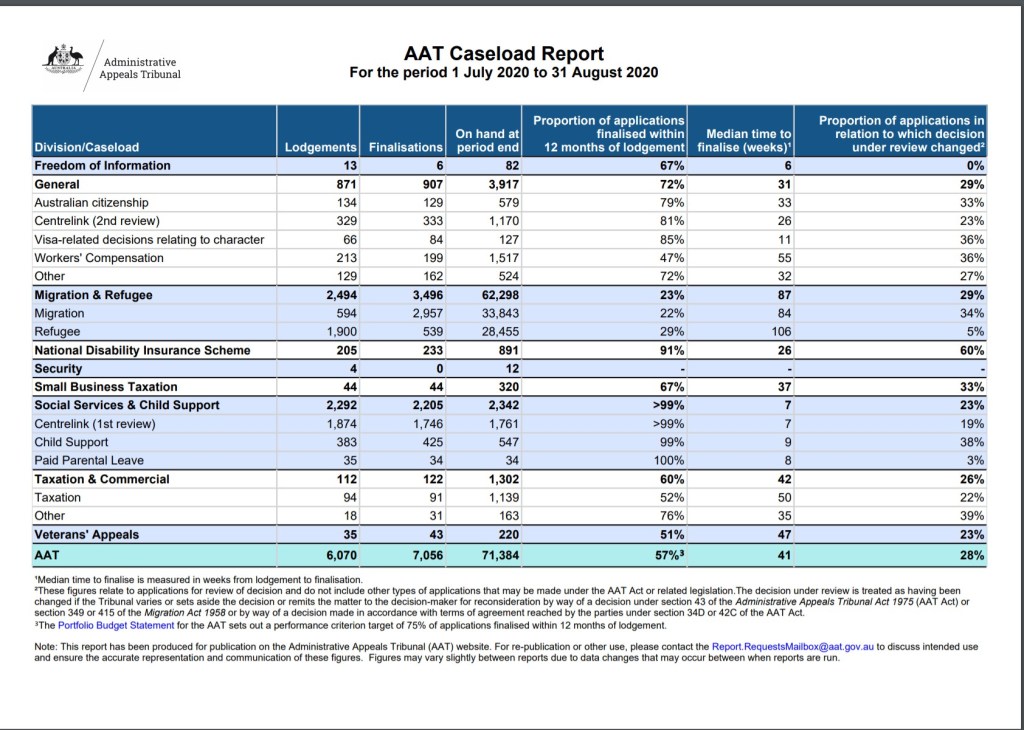
                        The following is the caseload report for the year 2020-21:

What decision can the AAT reach?

Generally, the AAT will reach one of the following conclusions:

  • Affirms the decision: this means that your review was unsuccessful and the decision made by the department remains unchanged;
  • Varies the decision: this means the decision has been changed or altered in some way;
  • Sets aside the decision and substitutes a new decision: this means it agrees or partially agrees that the decision was wrong and has changed all or part of the decision;
  • Sets aside and remits the decision: this means that the matter is sent back to the Department of Immigration to be decided again in accordance with its instructions or recommendations.

The AAT can also decide that it does not have jurisdiction to hear the decision.

What if you don’t agree with the AAT decision?

The AAT decision is not final. Further options that may be available are:

  • Judicial Review at the Federal Court in the event that the AAT made a legal error;
  • Ministerial Request to the Minister of Immigration and Border Protection following a negative AAT decision.

As you must have understood by now that applying for a review is very delicate and intimidating procedure.  You can book a consultation with us so that our immigration lawyers can assess your eligibility and tailor your application in accordance with your circumstances.